
You Carry a Gun. Why Aren't You Carrying a Tourniquet?
There is a gap in the way most people think about self-defense and it is a dangerous one. People spend serious money on a quality firearm, a good holster, defensive ammunition, and training. They think about the threat side of the equation constantly. But they almost never think about what happens after.
Gunfights are violent, chaotic, and fast. People get shot. Sometimes the bad guy, sometimes you, sometimes a bystander. Extremity wounds are the most common survivable gunshot injuries and they are also the most likely to kill someone before help arrives if the bleeding is not stopped immediately. A tourniquet fixes that. Nothing stops catastrophic extremity bleeding faster or more reliably.
If you carry a gun, you should be carrying a tourniquet too.
Why You Need One on You Right Now
Gunshot wounds to the extremities kill people who should have lived.
The data on this is not new. Lessons from military combat in Iraq and Afghanistan proved that most preventable deaths on the battlefield were caused by uncontrolled extremity hemorrhage. Not the wound itself. The bleeding. The military's Tactical Combat Casualty Care program made tourniquet carry mandatory for every soldier and saved thousands of lives as a result. That same principle applies to civilians.
If you are involved in a shooting, or you are nearby when one happens, someone may take a round to an arm or a leg. That person has minutes, not hours, before blood loss becomes fatal. EMS average response times in most cities run 7 to 10 minutes. In rural areas it can be 20 minutes or more. A severe arterial bleed in an extremity can kill in 3 to 5 minutes. You do the math.
The range is a high-risk environment that most people treat like it is not.
Think about what happens at a shooting range. Dozens of people handling firearms simultaneously. Some experienced, some not. Negligent discharges happen. Ricochets happen. Equipment failures happen. There is almost always a first aid kit somewhere at a commercial range, but getting to it takes time you may not have. If you are the closest person to someone who just took a round through the forearm, the tourniquet on your body is the one that matters.
You cannot predict where you will be when you need it.
Most people who carry a gun imagine using it in a self-defense scenario against a violent criminal. That is a legitimate concern. But tourniquets get used in car accidents, industrial accidents, farm equipment injuries, and construction site injuries just as often as they do in gunfights. If you are someone who takes personal responsibility for your own safety seriously, carrying a tourniquet is just the next logical step.
A Tourniquet Belongs in Every Vehicle
Motor vehicle accidents are one of the leading causes of traumatic extremity injuries in this country. Broken glass, metal intrusion, and impact trauma cause the same catastrophic bleeding that puts people into hemorrhagic shock. The difference between a survivable accident and a fatality is often how fast the bleeding gets controlled while everyone waits for EMS to arrive.
A tourniquet in your glove box or center console costs you almost nothing in convenience and could mean everything in the outcome. You do not have to be a gun owner to justify keeping one in your vehicle. You just have to drive.
The same logic applies to anyone working around power tools, farm equipment, heavy machinery, or construction environments. A table saw does not care who you are or how experienced you think you are. It just cuts. A tourniquet within reach of where you work is the same kind of common sense as keeping a fire extinguisher in the kitchen.
Bystander intervention saves lives. Hesitation does not.
If you are standing next to someone with a major arterial bleed and you do not have a tourniquet, your options become very limited very quickly. Direct pressure with your hands on a major arterial bleed is often not enough. Improvised tourniquets made from belts and shoelaces fail at unacceptable rates. A real tourniquet, applied correctly and quickly, works. Having it on your person means you can act in the first 60 seconds instead of spending that time looking for something that may not exist.
What to Carry
Get a CAT (Combat Application Tourniquet) or a SOFTT-W (Soft-T Wide). Both are proven, both are widely used by military and law enforcement, and both work. Do not buy cheap knockoffs from unknown brands. This is not a piece of gear to cut corners on.
Counterfeit CAT tourniquets are everywhere online, especially on Amazon and discount marketplaces. Some fail under tension or break when the windlass is tightened. Buy medical gear from reputable suppliers, not the cheapest listing you can find.
Carry it in a consistent location where you can reach it with either hand. An ankle pouch, a belt pouch, or a dedicated pocket in your range bag all work. The key is that you know exactly where it is and you can get to it under stress without thinking.
Tourniquets are not complicated, but they do need to be applied correctly and aggressively.
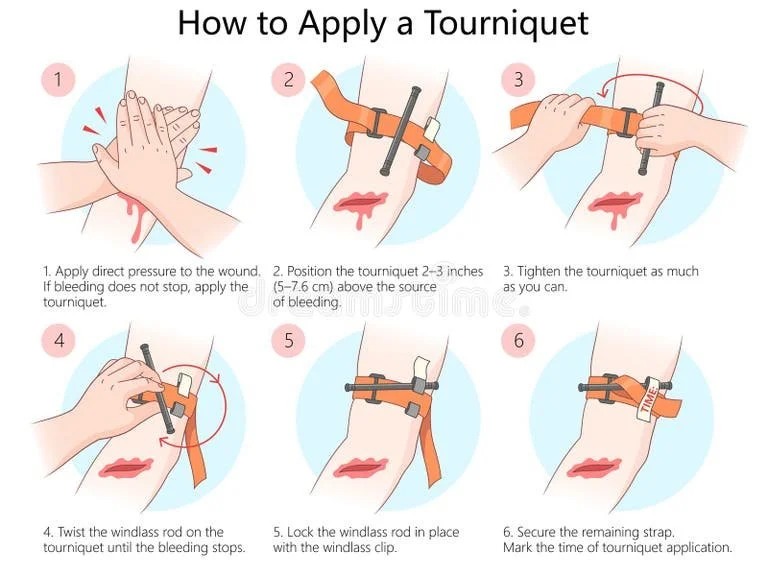
There is only one goal. Stop the bleeding fast enough that the person survives until a higher level of care can take over.
Step 1: Identify the wound.
Look for the source of the bleeding. Extremity wounds, arms and legs, are what a tourniquet is for. Tourniquets are not used on the neck, torso, or groin directly. If the wound is in one of those areas, you have a different problem that requires a different solution.
Step 2: Expose the limb if possible.
Cut or pull away clothing so you can see what you are working with. You need to place the tourniquet on bare skin or thin clothing, not over thick fabric, pockets, or seams.
Step 3: Place the tourniquet 2 to 3 inches above the wound.
Never place it directly on the wound or on a joint. Go above it on the limb toward the body. If the wound is close to the body and you cannot get 2 to 3 inches above it, place the tourniquet as high as possible on the limb.
Step 4: Thread and secure the strap.
Pull the strap through the buckle and pull it as tight as you can by hand before engaging the windlass. It should be snug against the skin with no slack.
Step 5: Twist the windlass until the bleeding stops.
This is the step people hesitate on. A tourniquet is supposed to hurt. You are cutting off circulation to a limb to save a life. Keep twisting until the bright red bleeding stops. If it is still bleeding, it is not tight enough.
Step 6: Lock the windlass and secure it.
Tuck the windlass into the retention clip or use the hook-and-loop straps to keep it from unwinding. A tourniquet that unwinds is a tourniquet that fails.
Step 7: Write the time on the tourniquet.
Every CAT and SOFTT-W has a white tab or band for writing the application time. Use a marker or pen, or write on the patient's forehead if you have to. EMS and trauma surgeons need to know how long the tourniquet has been on. Write the time. Do not skip this.
Step 8: Do not remove it.
Once a tourniquet is on, leave it on. Removing it in the field can cause sudden massive blood loss that may not be controllable again. Leave it for medical professionals to deal with.
A Note on Training
Reading this is a start. Actually applying a tourniquet under stress on a moving, panicked person is very different than reading about it or trying it once in a calm environment. Take a Stop the Bleed course. Practice with your actual tourniquet until you can apply it in under 60 seconds. Practice with one hand in case your other arm is the one that is injured.
The gun community trains draws, reloads, and malfunction clearances until they become automatic. Tourniquet application deserves the same standard.
Nexus Defense & Machine Co
